2.3 Weight factor transformations during a Monte Carlo choice
When a Monte Carlo choice must be performed, e.g. when the initial energy and direction of the neutron ray is decided at the source, it is important to adjust the neutron weight so that the combined effect of neutron weight change and Monte Carlo probability of making this particular choice equals the actual physical properties we like to model.
Let us follow up on the simple example of transmission. The probability of transmitting the real neutron is \(P\), but we make the Monte Carlo choice of transmitting the neutron ray each time: \(f_\mathrm {MC}=1\). This must be reflected on the choice of weight multiplier \(\pi _j=P\). Of course, one could simulate without weight factor transformation, in our notation written as \(f_\mathrm {MC}=P, \pi _j=1\). To generalize, weight factor transformations are given by the master equation \begin {equation} \label {e:probrule} f_\mathrm {MC} \pi _j = P . \end {equation}
This probability rule is general, and holds also if, e.g., it is decided to transmit only half of the rays \((f_\mathrm {MC}=0.5)\). An important different example is elastic scattering from a powder sample, where the Monte-Carlo choices are the particular powder line to scatter from, the scattering position within the sample and the final neutron direction within the Debye-Scherrer cone. This weight transformation is much more complex than described above, but still boils down to obeying the master transformation rule 2.9.
2.3.1 Direction focusing
An important application of weight transformation is direction focusing. Assume that the sample scatters the neutron rays in many directions. In general, only neutron rays in some of these directions will stand any chance of being detected. These directions we call the interesting directions. The idea in focusing is to avoid wasting computation time on neutrons scattered in the other directions. This trick is an instance of what in Monte Carlo terminology is known as importance sampling.
If e.g. a sample scatters isotropically over the whole \(4\pi \) solid angle, and all interesting directions are known to be contained within a certain solid angle interval \(\Delta \Ombold \), only these solid angles are used for the Monte Carlo choice of scattering direction. This implies \(f_\mathrm {MC}(\Delta \Omega ) = 1\). However, if the physical events are distributed uniformly over the unit sphere, we would have \(P(\Delta \Omega ) = \Delta \Omega / (4\pi )\), according to Eq. (2.9). One thus ensures that the mean simulated intensity is unchanged during a "correct" direction focusing, while a too narrow focusing will result in a lower (i.e. wrong) intensity, since we cut neutrons rays that should have reached the final detector.
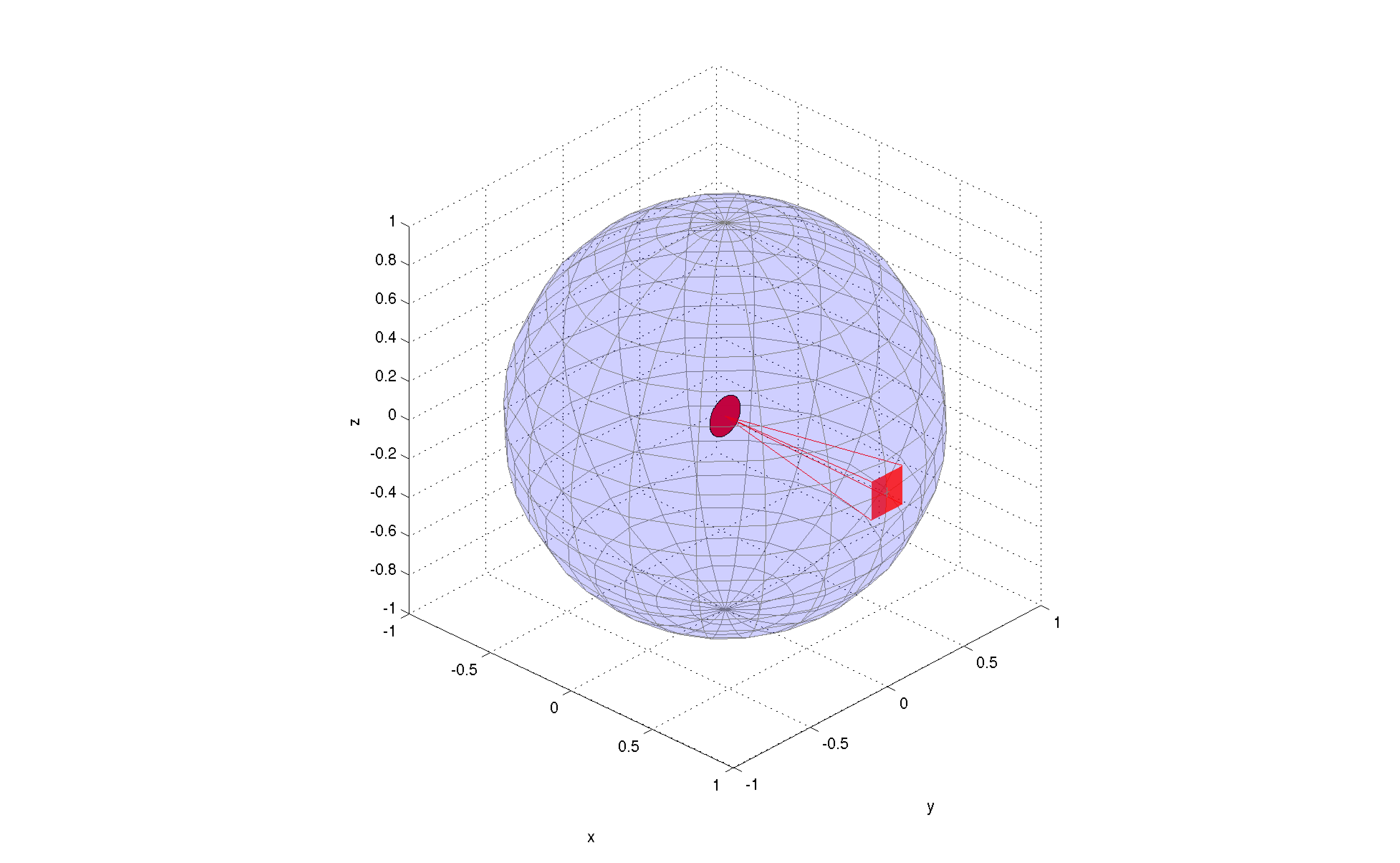
| Figure 2.1.: | Illustration of the effect of direction focusing in McStas. Weights of neutrons emitted into a certain solid angle are scaled down by the full unit sphere area. |