9.1 The Incoherent McStas Component
Incoherent sample (such as Vanadium) sample, with quasielastic component OR or global energy transfer.
Identification
-
Author: Kim Lefmann and Kristian Nielsen
-
Origin: Risoe
-
Date: 15.4.98
Description
A Double-cylinder shaped incoherent scatterer (like Vanadium) with both elastic and quasielastic (Lorentzian) components. No multiple scattering (but approximation available). Absorption included. Sample focusing: The area to scatter to is a disk of radius ’focus_r’ situated at the target. This target area may also be rectangular if specified focus_xw and focus_yh or focus_aw and focus_ah, respectively in meters and degrees. The target itself is either situated according to given coordinates (x,y,z), or defined with the relative target_index of the component to focus to (next is +1). This target position will be set to its AT position. When targeting to centered components, such as spheres or cylinders, define an Arm component where to focus to. Sample shape: Sample shape may be a cylinder, a sphere, a box or any other shape
box/plate: xwidth x yheight x zdepth (thickness=0)
hollow box/plate:xwidth x yheight x zdepth and thickness>0
cylinder: radius x yheight (thickness=0)
hollow cylinder: radius x yheight and thickness>0
sphere:          radius (yheight=0 thickness=0)
hollow sphere:   radius and thickness>0 (yheight=0)
any shape:       geometry=OFF file
The complex geometry option handles any closed non-convex polyhedra. It computes the intersection points of the neutron ray with the object transparently, so that it can be used like a regular sample object. It supports the PLY, OFF and NOFF file format but not COFF (colored faces). Such files may be generated from XYZ data using: qhull < coordinates.xyz Qx Qv Tv o > geomview.off or powercrust coordinates.xyz and viewed with geomview or java -jar jroff.jar (see below). The default size of the object depends of the OFF file data, but its bounding box may be resized using xwidth,yheight and zdepth.
Example: Incoherent(radius=0.05,focus_r=0.035, pack=1, target_index=1) Incoherent(geometry="socket.off",focus_r=0.035, pack=1, target_index=1)
Input parameters
Parameters in boldface are required; the others are optional.
|
Name |
Unit |
Description |
Default |
|
|
|||
|
geometry |
str |
Name of an Object File Format (OFF) or PLY file for complex geometry. The OFF/PLY file may be generated from XYZ coordinates using qhull/powercrust |
0 |
|
radius |
m |
Outer radius of sample in (x,z) plane |
0 |
|
xwidth |
m |
Horiz. dimension of sample (bounding box if off file), as a width |
0 |
|
yheight |
m |
Vert. dimension of sample (bounding box if off file), as a height. A sphere shape is used when 0 and radius is set |
0 |
|
zdepth |
m |
Depth of sample (bounding box if off file) |
0 |
|
thickness |
m |
Thickness of hollow sample |
0 |
|
target_x |
|
|
0 |
|
target_y |
m |
position of target to focus at |
0 |
|
target_z |
|
|
0 |
|
focus_r |
m |
Radius of disk containing target. Use 0 for full space |
0 |
|
focus_xw |
m |
horiz. dimension of a rectangular area |
0 |
|
focus_yh |
m |
vert. dimension of a rectangular area |
0 |
|
focus_aw |
deg |
horiz. angular dimension of a rectangular area |
0 |
|
focus_ah |
deg |
vert. angular dimension of a rectangular area |
0 |
|
target_index |
1 |
Relative index of component to focus at, e.g. next is +1 |
0 |
|
pack |
1 |
Packing factor |
1 |
|
p_interact |
1 |
MC Probability for scattering the ray; otherwise transmit |
1 |
|
f_QE |
1 |
Fraction of quasielastic scattering (rest is elastic) |
0 |
|
gamma |
1 |
Lorentzian width of quasielastic broadening (HWHM) |
0 |
|
Etrans |
meV |
Global energy-transfer, for use in inelastic settings |
0 |
|
deltaE |
meV |
Width in energy around Etrans, for use in inelastic settings |
0 |
|
sigma_abs |
barns |
Absorption cross section pr. unit cell at 2200 m/s |
5.08 |
|
sigma_inc |
barns |
Incoherent scattering cross section pr. unit cell |
5.08 |
|
Vc |
Å\(^{3}\) |
Unit cell volume |
13.827 |
|
concentric |
1 |
Indicate that this component has a hollow geometry and may contain other components. It should then be duplicated after the inside part (only for box, cylinder, sphere) |
0 |
|
order |
1 |
Limit multiple scattering up to given order 0 means all (default), 1 means single, 2 means double, ... |
0 |
|
|
|||
|
|
|||
|
|
|||
Links
-
Component source code found in file Incoherent.comp.
-
Cross sections for compounds
-
<A HREF="http://neutron.risoe.dk/mcstas/components/tests/Incoherent/">Test
-
results</A> (not up-to-date).
-
The test/example instrument vanadium_example.instr.
-
The test/example instrument QENS_test.instr.
-
Java version of Geomview (display only) jroff.jar
An incoherent scatterer, the V-sample
A sample with incoherent scattering, e.g. vanadium, is frequently used for calibration purposes, as this gives an isotropic, elastically scattered beam.
The component Incoherent has only absorption and incoherent elastic scattering. For the sample geometry, we default use a hollow cylinder (which has the solid cylinder as a limiting case). The sample dimensions are: outer radius radius, height yheight, and (for a hollow cylinder) wall thickness, see figure 9.2.
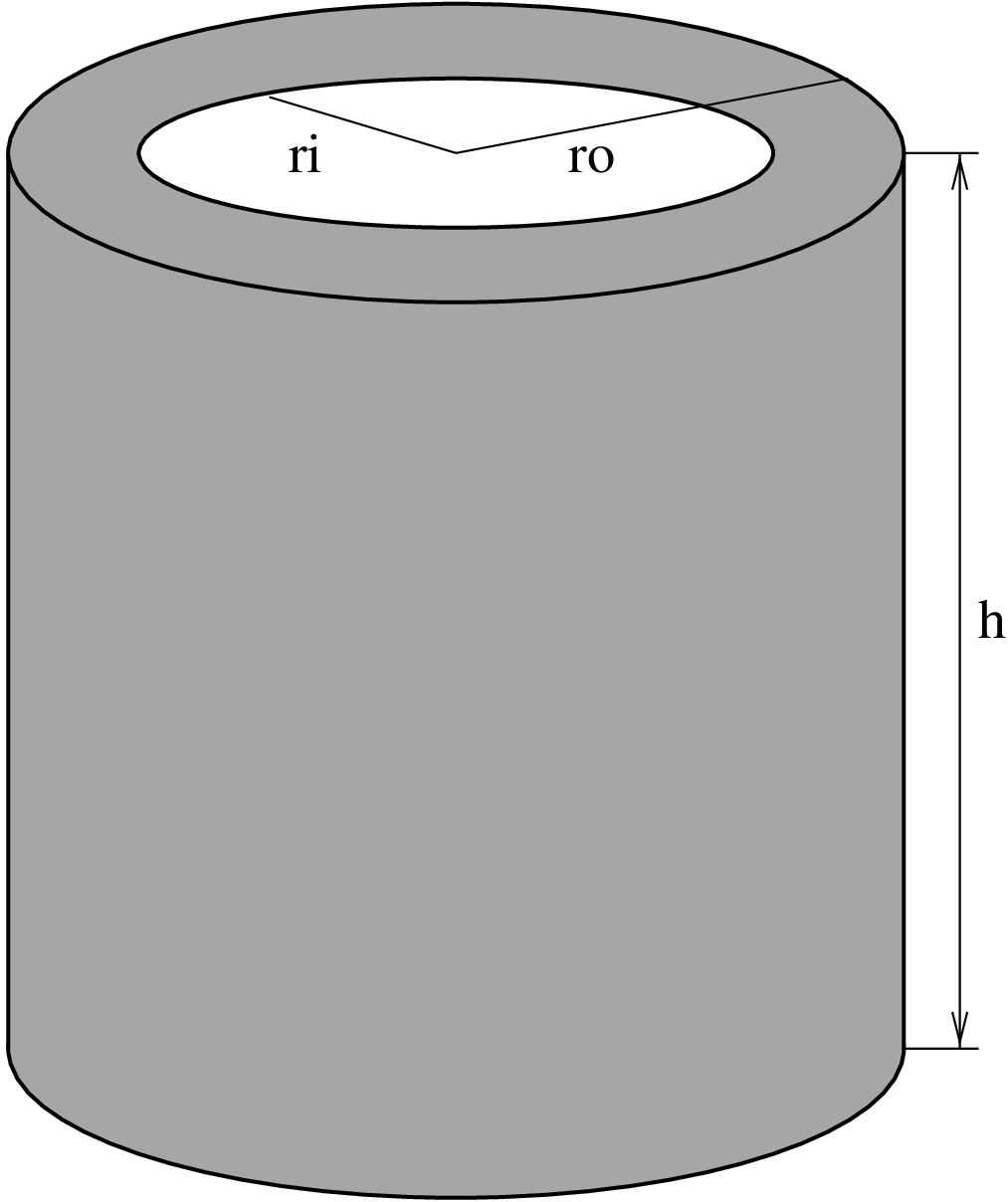
Alternatively, the sample geometry can be made rectangular by specifying the width, xwidth, the height, yheight, and the depth, zdepth.
The incoherent and absorption cross sections for V are default for the component. For other choices, the parameters sigma_inc, sigma_abs, and the unit cell volume Vc should be specified. For a loosely packed sample, also the packing factor, pack can be specified (default value of 1).
9.1.1 Physics and algorithm
The incoherent scattering gives a uniform angular distribution of the scattered neutrons from each nucleus: \(\gamma (\Omega ) = 1/4\pi \). For the focusing we choose to have a uniform distribution on a target sphere of radius focus_r, at the position (target_x,target_y,target_z) in the local coordinate system. This gives an angular distribution (in a small angle approximation) of \begin {equation} g(\Omega ) = \frac {1}{4\pi } \frac {x_\textrm {t}^2+y_\textrm {t}^2+z_\textrm {t}^2}{(\pi r_\textrm {t}^2)}. \end {equation}
The focusing can alternatively be performed on a rectangle with dimensions focus_xw,
focus_yh, or uniformly in angular space (in a small-angle approximation), using focus_aw,
focus_ah. The focusing location can be picked to be a downstream component by specifying
target_index.
When calculating the neutron path length within the cylinder, the kernel function
cylinder_intersect is used twice, once for the outer radius and once for the inner
radius.
Multiple scattering is not included in this component. To obtain intensities similar to real measured ones, we therefore do not take attenuation from scattering into account for the outgoing neutron ray.
9.1.2 Remark on functionality
When simulating a realistic incoherent hollow cylinder sample one finds that the resulting direction dependence of the scattered intensity is not isotropic. This is explained by the variation of attenuation with scattering angle. One test result is shown in the instrument example chapter of the McStas User Manual.
The Samples_vanadium and Samples_incoherent test/example instruments exist in the distribution for this component.