8.2 The Monochromator_curved McStas Component
Double bent multiple crystal slabs with anisotropic gaussian mosaic.
Identification
-
Author: Emmanuel Farhi, Kim, Lefmann, Peter Link
-
Origin: <a href="http://www.ill.fr">ILL</a>
-
Date: Aug. 24th 2001
Description
Double bent infinitely thin mosaic crystal, useful as a monochromator or analyzer. which uses a small-mosaicity approximation and taking into account higher order scattering. The mosaic is anisotropic gaussian, with different FWHMs in the Y and Z directions. The scattering vector is perpendicular to the surface. For an unrotated monochromator component, the crystal plane lies in the y-z plane (ie. parallel to the beam). The component works in reflection, but also transmits the non-diffracted beam. Reflectivity and transmission files may be used. The slabs are positioned in the vertical plane (not on a cylinder/sphere), and are rotated according to the curvature radius. When curvatures are set to 0, the monochromator is flat. The curvatures approximation for parallel beam focusing to distance L, with monochromator rotation angle A1 are: RV = 2*L*sin(DEG2RAD*A1); RH = 2*L/sin(DEG2RAD*A1);
When you rotate the component by A1 = asin(Q/2/Ki)*RAD2DEG, do not forget to rotate the following components by A2=2*A1 (for 1st order) !
Example: Monochromator_curved(zwidth=0.01, yheight=0.01, gap=0.0005, NH=11, NV=11, mosaich=30.0, mosaicv=30.0, r0=0.7, Q=1.8734)
Monochromator lattice parameter
PG       002 DM=3.355 AA (Highly Oriented Pyrolythic Graphite)
PG       004 DM=1.677 AA
Heusler 111 DM=3.362 Å (Cu2MnAl)
CoFe         DM=1.771 AA (Co0.92Fe0.08)
Ge       111 DM=3.266 AA
Ge       311 DM=1.714 AA
Ge       511 DM=1.089 AA
Ge       533 DM=0.863 AA
Si       111 DM=3.135 AA
Cu       111 DM=2.087 AA
Cu       002 DM=1.807 AA
Cu       220 DM=1.278 AA
Cu       111 DM=2.095 AA
Input parameters
Parameters in boldface are required; the others are optional.
|
Name |
Unit |
Description |
Default |
|
|
|||
|
reflect |
str |
reflectivity file name of text file as 2 columns [k, R] |
"NULL" |
|
transmit |
str |
transmission file name of text file as 2 columns [k, T] |
"NULL" |
|
zwidth |
m |
horizontal width of an individual slab |
0.01 |
|
yheight |
m |
vertical height of an individual slab |
0.01 |
|
gap |
m |
typical gap between adjacent slabs |
0.0005 |
|
NH |
int |
number of slabs horizontal |
11 |
|
NV |
int |
number of slabs vertical |
11 |
|
mosaich |
arc minutes |
Horisontal mosaic FWHM |
30.0 |
|
mosaicv |
arc minutes |
Vertical mosaic FWHM |
30.0 |
|
r0 |
1 |
Maximum reflectivity. O unactivates component |
0.7 |
|
t0 |
1 |
transmission efficiency |
1.0 |
|
Q |
Å\(^{-1}\) |
Scattering vector |
1.8734 |
|
RV |
m |
radius of vertical focussing. flat for 0 |
0 |
|
RH |
m |
radius of horizontal focussing. flat for 0 |
0 |
|
DM |
Å |
monochromator d-spacing instead of Q=2*pi/DM |
0 |
|
mosaic |
arc minutes |
sets mosaich=mosaicv |
0 |
|
width |
m |
total width of monochromator, along Z |
0 |
|
height |
m |
total height of monochromator, along Y |
0 |
|
verbose |
0/1 |
verbosity level |
0 |
|
order |
1 |
specify the diffraction order, 1 is usually prefered. Use 0 for all |
0 |
|
|
|||
|
|
|||
|
|
|||
Links
-
Component source code found in file Monochromator_curved.comp.
-
Additional note from Peter Link.
-
Obsolete Mosaic_anisotropic by Kristian Nielsen
-
Contributed Monochromator_2foc by Peter Link
A curved mosaic crystal with a single scattering vector
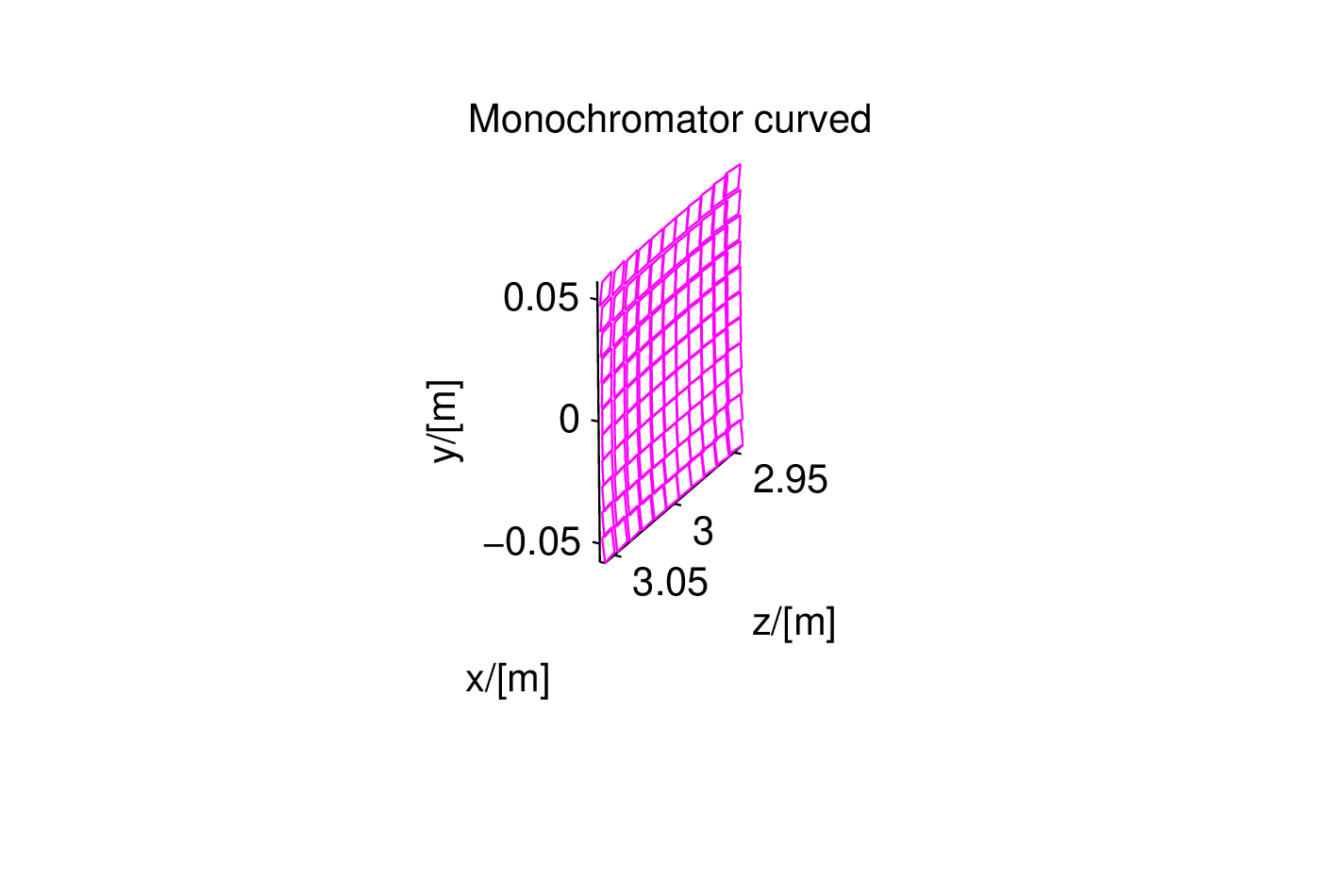
This component simulates an array of infinitely thin single crystals with a single scattering vector perpendicular to the surface and a mosaic spread. This component is used to simulate a singly or doubly curved monochromator or analyzer in reflecting geometry.
The component uses rectangular pieces of monochromator material as described in Monochromator_curved. The scattering vector is named \(Q\), and as described in Monochromator_flat, multiples of \(Q\) will be applied. Other important parameters are the piece height and width, \(y_\textrm {h}\) and \(z_\textrm {w}\), respectively, the horizontal and vertical mosaicities, \(\eta _\textrm {h}\) and \(\eta _\textrm {v}\), respectively. If just one mosaicity, \(\eta \), is specified, this the same for both directions.
The number of pieces vertically and horizontally are called \(n_\textrm {v}\) and \(n_\textrm {h}\), respectively, and the vertical and horizontal radii of curvature are named \(r_\textrm {v}\) and \(r_\textrm {h}\), respectively. All single crystals are positioned in the same vertical plane, but tilted accordingly to the curvature radius.
The constant monochromator reflectivity, \(R_0\) can be replaced by a file of tabulated reflectivities \(reflect\) (*.rfl in MCSTAS/data). In the same sense, the transmission can be modeled by a tabulated file \(transmit\) (for non-reflected neutrons, *.trm in MCSTAS/data). The most useful of these files for Monochromator_curved are HOPG.rlf and HOPG.trm.
As for Monochromator_flat, the crystal is assumed to be infinitely thin, and the variation in lattice spacing, (\(\Delta d/d\)), is assumed to be zero. Hence, this component is not suitable for simulating backscattering instruments or to investigate multiple scattering effects.
The theory and algorithm for scattering from the individual blades is described under Monochromator_flat.