6.4 The V_selector McStas Component
Velocity selector.
Identification
-
Author: Kim Lefmann
-
Origin: Risoe
-
Date: Nov 25, 1998
Description
Velocity selector consisting of rotating Soller-like blades defining a helically twisted passage. Geometry defined by two identical, centered apertures at 12 o’clock position, Origo is at the centre of the selector (input is at -zdepth/2). Transmission is analytical assuming a continuous source.
Example: V_selector(xwidth=0.03, yheight=0.05, zdepth=0.30, radius=0.12, alpha=48.298, length=0.25, d=0.0004, nu=20000, nslit=72) These are values for the D11@ILL Dornier ’Dolores’ Velocity Selector (NVS 023)
%VALIDATION Jun 2005: extensive external test, no problems found Validated by: K. Lieutenant
Input parameters
Parameters in boldface are required; the others are optional.
|
Name |
Unit |
Description |
Default |
|
|
|||
|
xwidth |
m |
Width of entry aperture |
0.03 |
|
yheight |
m |
Height of entry aperture |
0.05 |
|
zdepth |
m |
Distance between apertures, for housing containing the rotor |
0.30 |
|
radius |
m |
Height from aperture centre to rotation axis |
0.12 |
|
alpha |
deg |
Twist angle along the cylinder |
48.298 |
|
length |
m |
Length of cylinder/rotor (less than zdepth) |
0.25 |
|
d |
m |
Thickness of blades |
0.0004 |
|
nu |
Hz |
Cylinder rotation speed, counter-clockwise, which is ideally 3956*alpha*DEG2RAD/2/PI/lambda/length |
300 |
|
nslit |
1 |
Number of Soller blades |
72 |
|
|
|||
|
|
|||
|
|
|||
Links
-
Component source code found in file V_selector.comp.
A rotating velocity selector
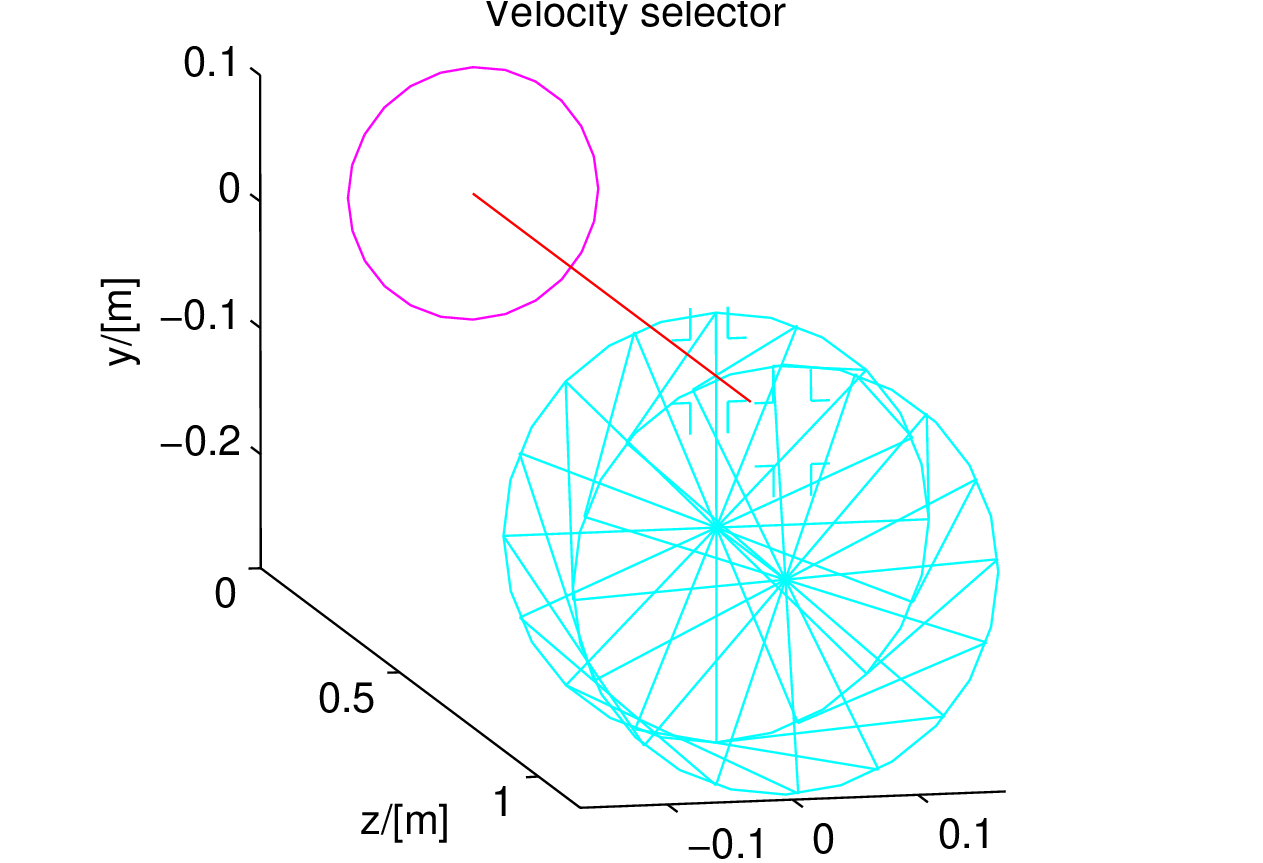
The component V_selector models a rotating velocity selector constructed from \(N\) collimator blades arranged radially on an axis. Two identical slits (\(height \times width\)) at a 12 o’clock position allow neutron passage at the position of the blades. The blades are "twisted" on the axis so that a stationary velocity selector does not transmit neutrons; the total twist angle is denoted \(\phi \) (in degrees).
Further input parameters for V_selector the distance between apertures, \(L_0\), the length of the collimator blades, \(L_1\), the height from rotation axix to the slit centre, \(r_0\), the rotation speed \(\omega \) (in rpm), and the blade thickness \(t\).
The local coordinate system has its Origo at the slit centre.
The component Selector produces equivalent results.
Velocity selector transmission
By rotating the selector you allow transmittance of neutrons rays with velocities around a nominal value, given by \begin {equation} V_0 = \omega L / \phi , \end {equation} which means that the selector has turned the twist angle \(\phi \) during the typical neutron flight time \(L/V_0\). The actual twist angle is \(\phi ' = \omega t = \omega L / V\).
Neutrons having a velocity slightly different from \(V_0\) will either be transmitted or absorbed depending on the exact position of the rotator blades when the neutron enters the selector. Assuming this position to be unknown and integrating over all possible positions (assuming zero thickness of blades), we arrive at a transmission factor \begin {equation} T = \left \{ \begin {array}{ll} 1 - (N/2\pi ) |\phi -\omega L / V| & \textrm {if}\; (N/2\pi )|\phi -\omega L / V| < 1 \\ 0 & \textrm {otherwise} \end {array} \right . \end {equation} where \(N\) is the number of collimator blades.
A horisontal divergence changes the above formula because of the angular difference between the entry and exit points of the neutron. The resulting transmittance resembles the one above, only with \(V\) replaced by \(V_z\) and \(\phi \) replaced by \((\phi +\psi )\), where \(\psi \) is the angular difference due to the divergence. An additional vertical divergence does not change this formula, but it may contribute to \(\psi \). (We have here ignored the very small non-linearity of \(\psi \) along the neutron path in case of both vertical and horisontal divergence).
Adding the effect of a finite blade thickness, \(t\), reduces the transmission by the overall factor \begin {equation} \left ( 1-\frac {N t}{2\pi r} \right ), \end {equation} where \(r\) is the distance from the rotation axis. We ignore the variation of \(r\) along the neutron path and use just the average value.