4.5 The Collimator_linear McStas Component
A simple analytical Soller collimator (with triangular transmission).
Identification
-
Author: Kristian Nielsen
-
Origin: Risoe
-
Date: August 1998
Description
Soller collimator with rectangular opening and specified length. The transmission function is an average and does not utilize knowledge of the actual neutron trajectory. A zero divergence disables collimation (then the component works as a double slit).
Example: Collimator_linear(xmin=-0.1, xmax=0.1, ymin=-0.1, ymax=0.1, length=0.25, divergence=40,transmission=0.7)
Input parameters
Parameters in boldface are required; the others are optional.
|
Name |
Unit |
Description |
Default |
|
|
|||
|
xmin |
m |
Lower x bound on slits |
-0.02 |
|
xmax |
m |
Upper x bound on slits |
0.02 |
|
ymin |
m |
Lower y bound on slits |
-0.05 |
|
ymax |
m |
Upper y bound on slits |
0.05 |
|
xwidth |
m |
Width of slits |
0 |
|
yheight |
m |
Height of slits |
0 |
|
length |
m |
Distance between input and output slits |
0.3 |
|
divergence |
minutes of arc |
Divergence horizontal angle (calculated as atan(d/length), where d is the blade spacing) |
40 |
|
transmission |
1 |
Transmission of Soller (0<=t<=1) |
1 |
|
divergenceV |
minutes of arc |
Divergence vertical angle |
0 |
|
|
|||
|
|
|||
|
|
|||
Links
-
Component source code found in file Collimator_linear.comp.
The simple Soller blade collimator
Collimator_linear models a standard linear Soller blade collimator. The collimator has two identical rectangular openings, defined by the \(x\) and \(y\) values. Neutrons not clearing both openings are ABSORB’ed. The length of the collimator blades is denoted \(L\), while the distance between blades is called \(d\).
The collimating effect is taken care of by employing an approximately triangular transmission through the collimator of width (FWHM) \(\delta \), which is given in arc minutes, i.e. \(\delta =60\) is one degree. If \(\delta =0\), the collimating effect is disabled, so that the component only consists of two rectangular apertures.
For a more detailed Soller collimator simulation, taking every blade into account, it is possible to use Channeled_guide with absorbing walls, see section 5.1.0.0.
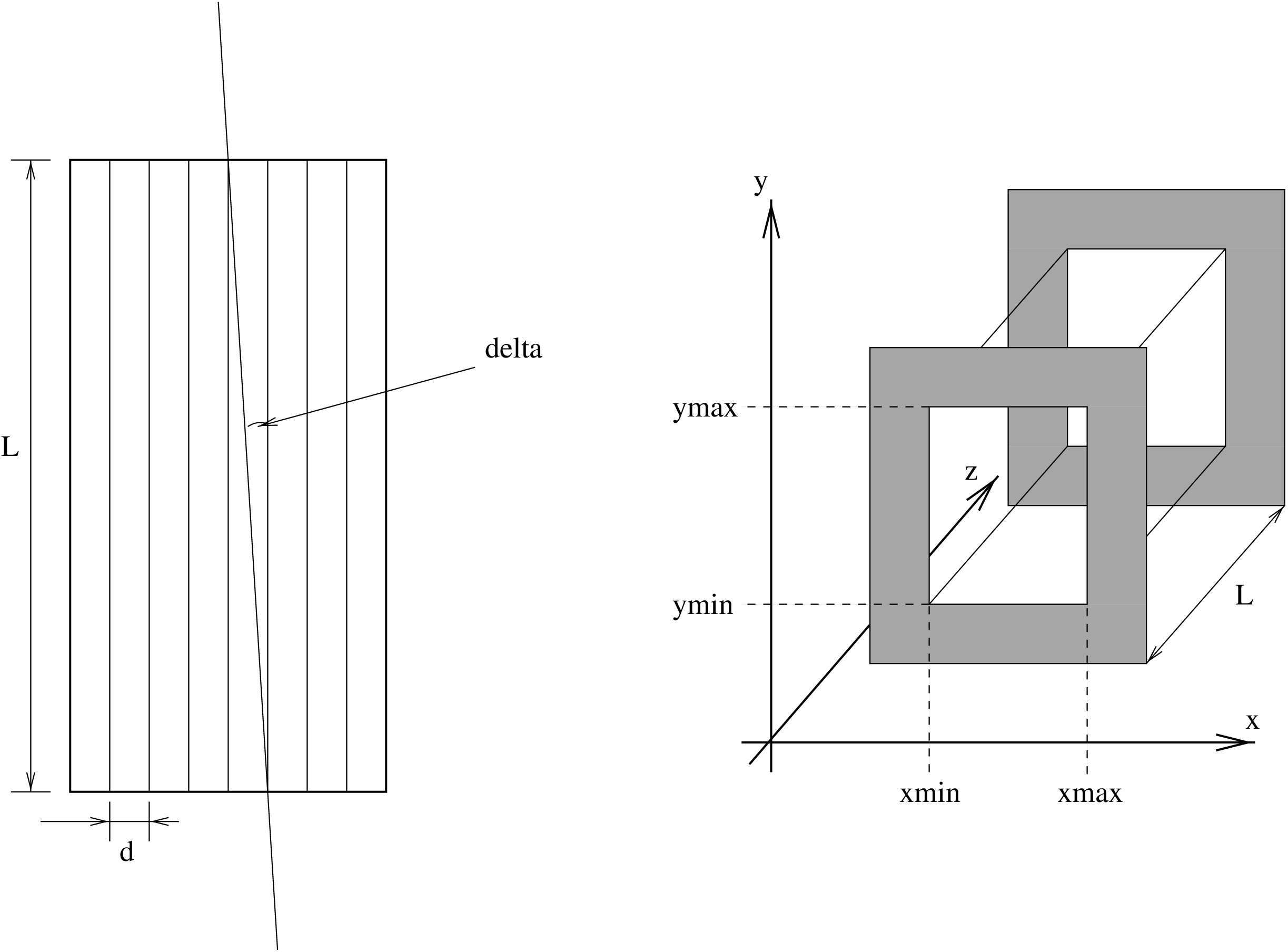
| Figure 4.1.: | The geometry of a simple Soller blade collimators: The real Soller collimator, seen from the top (left), and a sketch of the component Soller (right). The symbols are defined in the text. |
Collimator transmission
The horizontal divergence, \(\eta _h\), is defined as the angle between the neutron path and the vertical \(y-z\) plane along the collimator axis. We then define the collimation angle as the maximal allowed horizontal divergence: \(\delta = \tan ^{-1}(d/L)\), see Fig. 4.1. Neutrons with a horizontal divergence angle \(|\eta _h| \geq \delta \) will always hit at least one collimator blade and will thus be ABSORB’ed. For smaller divergence angles, \(|\eta _h| < \delta \), the fate of the neutron depends on its exact entry point. Assuming that a typical collimator has many blades, the absolute position of each blade perpendicular to the collimator axis is thus mostly unimportant. A simple statistical consideration now shows that the transmission probability is \(T = 1-\tan |\eta _h|/\tan \delta \). Often, the approximation \(T \approx 1-|\eta _h|/\delta \) is used, giving a triangular transmission profile.
Algorithm
The algorithm of Collimator_linear is roughly as follows: