4.6 The Collimator_radial McStas Component
A radial Soller collimator.
Identification
-
Author: Emmanuel Farhi <farhi@ill.fr>
-
Origin: ILL
-
Date: July 2005
Description
Radial Soller collimator with rectangular opening and specified length. The collimator is made of many rectangular channels stacked radially. Each channel is a set of transmitting layers (nslit), separated by an absorbing material (infinitely thin), the whole stuff is inside an absorbing housing.
When specifying the number of channels (nchan), each channel has a total entrance width=radius*fabs(theta_max-theta_min)/nchan, but only the central portion ’xwidth’ accepts neutrons. When xwidth=0, it is set to the full apperture so that all neutrons enter the channels (all walls are infinitely thin).
When using zero as the number of channels (nchan), the collimator is continuous, whithout shadowing effect.
The component should be positioned at the radius center. The component can be made oscillating (usual on diffractometers and TOF machines) with the ’roc’ parameter. The neutron beam outside the collimator angular area is transmitted unaffected.
When used as a focusing collimator, the focusing parameter should be set to 1.
An example of a instrument that uses this collimator can be found in the SALSA instrument, in the example folder
Example: Channelled radial collimator with shadow parts Collimator_radial(xwidth=0.015, yheight=.3, length=.35, divergence=40,transmission=1, theta_min=5, theta_max=165, nchan=128, radius=0.9) A continuous radial collimator Collimator_radial(yheight=.3, length=.35, divergence=40,transmission=1, theta_min=5, theta_max=165, radius=0.9)
Input parameters
Parameters in boldface are required; the others are optional.
|
Name |
Unit |
Description |
Default |
|
|
|||
|
xwidth |
m |
Soller window width, filled with nslit slits. Use 0 value for continuous collimator. |
0 |
|
yheight |
m |
Collimator height. If yheight_inner is specified, then this is the outer cylinders height |
.3 |
|
length |
m |
Length/Distance between inner and outer slits. |
.35 |
|
divergence |
min of arc |
Divergence angle. May also be specified with the nslit parameter. A zero value unactivates component. |
0 |
|
transmission |
1 |
Maximum transmission of Soller (0<=t<=1). |
1 |
|
theta_min |
deg |
Minimum Theta angle for the radial setting. |
5 |
|
theta_max |
deg |
Maximum Theta angle for the radial setting. |
165 |
|
nchan |
1 |
Number of Soller channels in the theta range. Use 0 value for continuous collimator. |
0 |
|
radius |
m |
Radius of the collimator (to entry window). |
1.3 |
|
nslit |
1 |
Number of blades composing each Soller. Overrides the divergence parameter. |
0 |
|
roc |
deg |
Amplitude of oscillation of collimator. 0=fixed. |
0 |
|
verbose |
|
Gives additional information. |
0 |
|
approx |
|
Use Soller triangular transmission approximation. |
0 |
|
focusing |
1 |
When set allows you to use the collimators for focusing, rather than dispersing. |
0 |
|
yheight_inner |
1 |
Defines the inner height of the collimator |
0 |
|
|
|||
|
|
|||
|
|
|||
Links
-
Component source code found in file Collimator_radial.comp.
A radial Soller blade collimator
| Name: | Collimator_radial |
| Author: | (System) E.Farhi, ILL |
| Input parameters | \(w_1\), \(h_1\), \(w_2\), \(h_2\), \(len\), \(\theta _{min}\), \(\theta _{max}\), \(nchan\), \(radius\) |
| Optional parameters | \(divergence\), \(nblades\), \(roc\) and others |
| Notes | Validated |
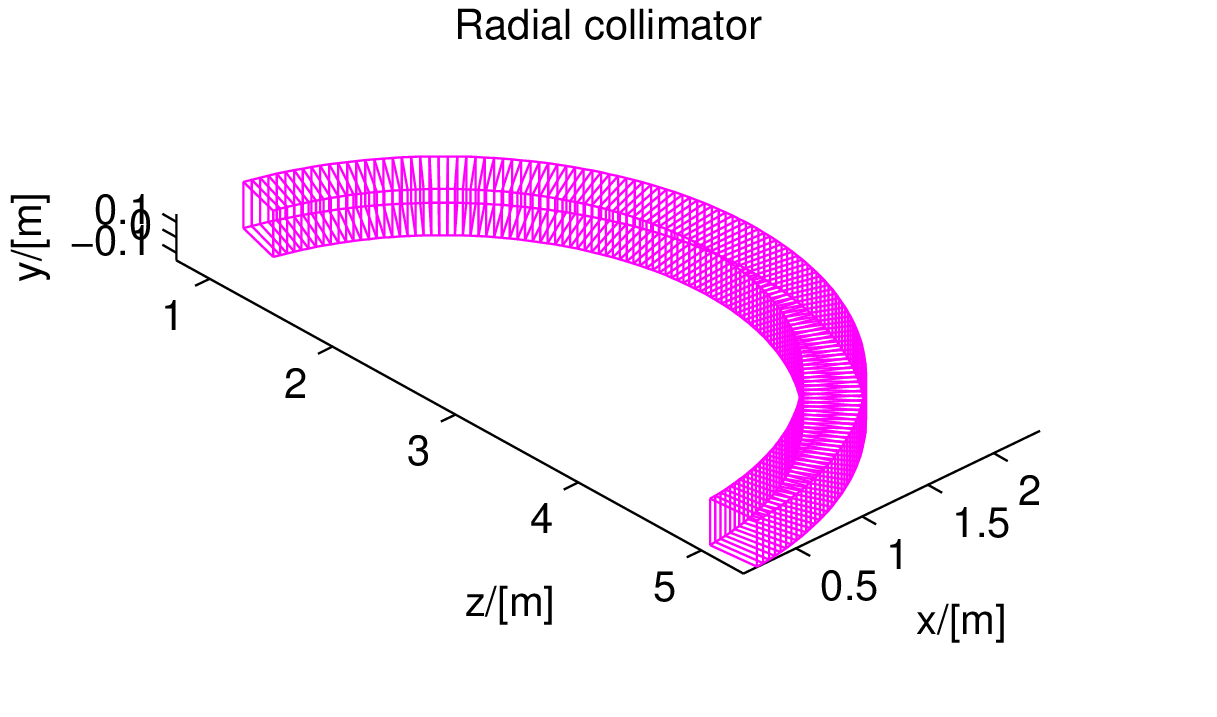
This radial collimator works either using an analytical approximation like Collimator_linear (see section 4.5), or with an exact model.
The input parameters are the inner radius \(radius\), the radial length \(len\), the input and output window dimensions \(w_1\), \(h_1\), \(w_2\), \(h_2\), the number of Soller channels \(nchan\) (each of them being a single linear collimator) covering the angular interval [\(\theta _{min}\), \(\theta _{max}\)] angle with respect to the \(z\)-axis.
If the \(divergence\) parameter is defined, the approximation level is used as in Collimator_linear (see section 4.5). On the other hand, if you perfer to describe exactly the number of blades \(nblades\) assembled to build a single collimator channel, then the model is exact, and traces the neutron trajectory inside each Soller. The computing efficiency is then lowered by a factor 2.
The component can be made oscillating with an amplitude of \(roc\) times \(\pm w_1\), which supresses the channels shadow.
As an alternative, you may use the Exact_radial_coll contributed component. For a rectangular shaped collimator, instead of cylindrical/radial, you may use the Guide_channeled and the Guide_gravity components.